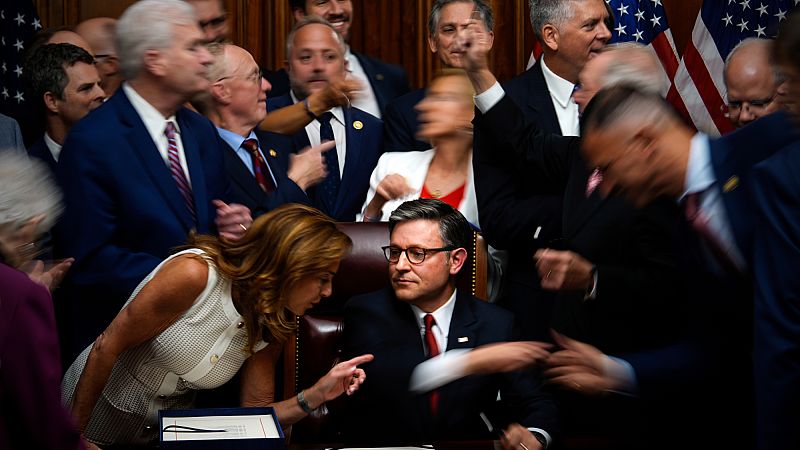
Republicans muscled President Donald Trump's tax and spending cut bill through the House on Thursday, the final step necessary to get the proposal to his desk by the GOP's self-imposed deadline of July 4th.
At nearly 900 pages, the legislation is a sprawling collection of tax breaks, spending cuts and other Republican priorities, including new money for national defence and deportations.
Democrats united against the legislation, but were powerless to stop it as long as Republicans stayed united. The Senate passed the bill, with Vice President JD Vance casting the tiebreaking vote. The House passed an earlier version of the bill in May with only one vote to spare. It passed the final version with a 218 to 214 split.
Here's the latest on what's in the bill and when some of its provisions go into effect.
GOP bill includes reductions for businesses and new tax breaks
Republicans say the bill is crucial because there would be a massive tax increase after December when tax breaks from Trump's first term expire. The legislation contains about $4.5 trillion (€3.8tn) in tax cuts.
The existing tax rates and brackets would become permanent under the bill, solidifying the tax cuts approved in Trump's first term.
It would temporarily add new tax deductions on tips, overtime, and auto loans. There's also a $6,000 deduction for older adults who earn no more than $75,000 a year (€63,000), which is a nod to his pledge to end taxes on Social Security benefits.
It would increase the $2,000 child tax credit to $2,200 (€1,900). Millions of families at lower income levels would not receive the full credit.
A cap on state and local deductions, called SALT, would quadruple to $40,000 (€34,000) for five years. It's a provision important to New York and other high tax states, though the House wanted it to last for 10 years.
There are numerous business-related tax cuts, including allowing companies to immediately deduct 100% of the cost of equipment and research. Supporters argue that this will stimulate economic growth.
The wealthiest households would see a $12,000 (€10,000) increase from the legislation, and the bill would cost the poorest people $1,600 (€1,400) a year, mainly due to reductions in Medicaid and food aid, according to the non-partisan Congressional Budget Office analysis of the House's version.
Legislation funds the border wall and deportations
The bill would provide some $350 billion (€300bn) for Trump's border and national security agenda, including for the US-Mexico border wall and for 100,000 migrant detention facility beds, as he aims to fulfill his promise of the largest mass deportation operation in US history.
Money would go for hiring 10,000 new Immigration and Customs Enforcement officers, with $10,000 (€8,500) signing bonuses and a surge of Border Patrol officers, as well. The goal is to deport some 1 million people per year.
To help pay for it, immigrants would face various new fees, including when seeking asylum protections.
For the Pentagon, the bill would provide billions for shipbuilding, munitions systems, and quality of life measures for servicemen and women, as well as $25 billion (€21 billion) for the development of the Golden Dome missile defense system. The Defense Department would have $1 billion for border security.
Medicaid and SNAP face significant cuts.
To help partly offset the lost tax revenue and new spending, Republicans aim to cut back on Medicaid and food assistance for people below the poverty line.
Republicans argue they are trying to rightsize the safety net programs for the population they were initially designed to serve, mainly pregnant women, the disabled and children, and root out what they describe as waste, fraud and abuse.
The package includes new 80-hour-a-month work requirements for many adults receiving Medicaid and food stamps, including older individuals up to age 65. Parents of children aged 14 and older would be required to meet the program's work requirements.
There is also a proposed new $35 co-payment that may be charged to patients utilizing Medicaid services.
More than 71 million people rely on Medicaid, which expanded under Obama's Affordable Care Act, and 40 million use the Supplemental Nutrition Assistance Program. Most already work, according to analysts.
The Congressional Budget Office estimates that 11.8 million more Americans would become uninsured by 2034 if the bill became law, and 3 million more would not qualify for food stamps, also known as SNAP benefits.
Republicans are seeking to have states cover part of the cost for SNAP benefits. At present, all benefit costs are funded by the federal government. Under the bill, starting in 2028, states will be required to contribute a fixed percentage of those costs if their payment error rate exceeds 6%. Payment errors include both underpayments and overpayments.
"Big beautiful" bill slashes clean energy tax credits
Republicans are proposing to dramatically roll back tax breaks designed to boost clean energy projects fueled by renewable sources such as solar and wind. The tax breaks were a central component of President Joe Biden's 2022 landmark bill focused on addressing climate change and lowering health care costs.
Democratic Senator for Oregon Ron Wyden went so far as to call the GOP provisions a "death sentence for America's wind and solar industries and an inevitable hike in utility bills".
A tax break for people who buy new or used electric vehicles would expire on 30 September of this year, instead of at the end of 2032 under current law.
Meanwhile, a tax credit for the production of critical materials will be expanded to include metallurgical coal used in steelmaking.
Bill reduces a gun tax and restricts Medicaid access for abortion providers
Several additional provisions reflect other Republican priorities.
The bill creates a new children's savings program, called Trump Accounts, with a potential $1,000 (€850) deposit from the Treasury.
The Senate allocated $40 million (€34 million) to establish Trump's long-sought "National Garden of American Heroes."
There's a new excise tax on university endowments and a new tax on remittances, or transfers of money that people in the US send abroad.
A $200 (€170) tax on gun silencers and short-barreled rifles and shotguns was eliminated.
One provision prohibits Medicaid payments to family planning providers that perform abortions, specifically Planned Parenthood, for one year.
Additionally, a provision would increase the nation's debt limit by $5 trillion (€4.2 trillion) to allow continued borrowing to pay already accrued bills.
State AI regulations removed from bill following a Republican outcry
The Senate overwhelmingly revolted against a proposal meant to deter states from regulating artificial intelligence. Republican governors across the country asked for the moratorium to be removed and the Senate voted to do so with a resounding 99-1 vote.
A provision was thrown in at the final hours that will provide $10 billion annually to rural hospitals for five years, or $50 billion in total (€42 billion). The Senate bill had originally provided $25 billion for the program, but that number was upped to win over holdout GOP senators and a coalition of House Republicans warning that reduced Medicaid provider taxes would hurt rural hospitals.
The amended bill also removed a new tax on wind and solar projects that utilize a certain percentage of components from China.
Final price tag: GOP bill could add $3.3tn to deficit
Altogether, the Congressional Budget Office projects that the bill would increase federal deficits over the next 10 years by nearly $3.3 trillion (€2.8 trillion) from 2025 to 2034. An increase in public debt would likely make government borrowing more expensive as investors may view Treasuries as a riskier proposition.
Senate Republicans nonetheless reject the projections by proposing a unique strategy of not counting the existing tax breaks as a new cost because those breaks are already "current policy". Republican senators say the Senate Budget Committee chairman has the authority to set the baseline for the preferred approach.
According to the alternative Senate GOP view, the bill would reduce deficits by nearly half a trillion dollars over the coming decade, the CBO said.
Democrats say this is "magic math" that obscures the true costs of the tax breaks. Some non-partisan groups worried about the country's fiscal trajectory are siding with Democrats in that regard. The Committee for a Responsible Federal Budget says Senate Republicans were employing an "accounting gimmick that would make Enron executives blush."



0 komentar:
Posting Komentar