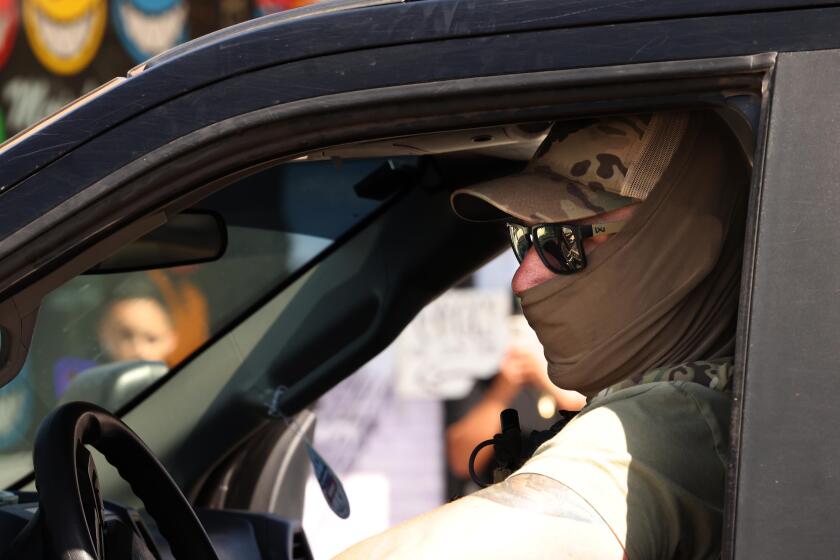
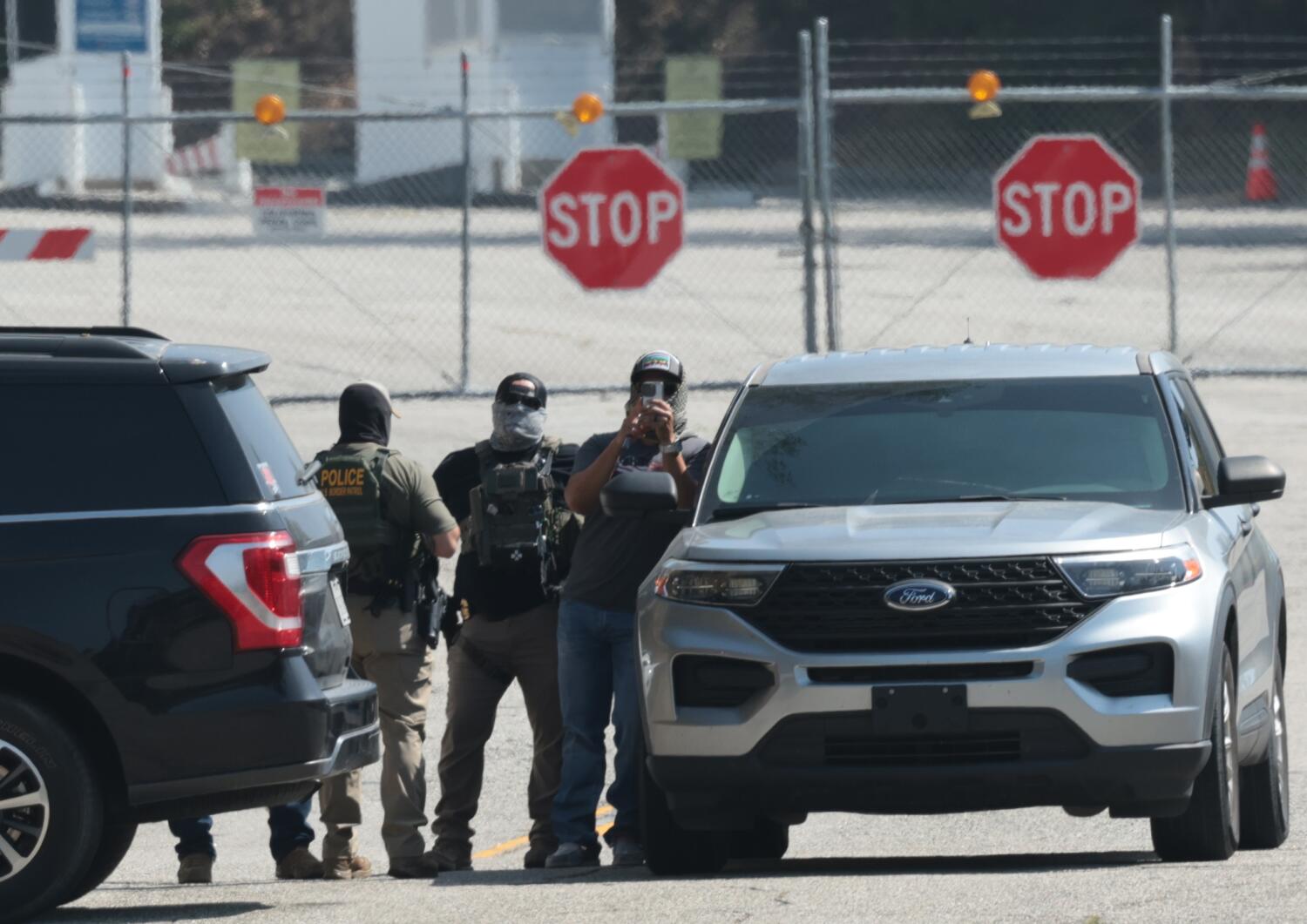
For many Angelenos, the spectacle of armed federal agents — faces hidden behind neck gaiters and balaclavas — jumping out of unmarked vans to snatch people off the streets presents a clear threat to public safety.
As federal immigration agents have increased enforcement raids, arresting and detaining anyone they suspect of violating immigration laws, critics warn their tactic of blending in - particularly when wearing plain clothes and no visible marker of identity - spreads fear and panic across communities and endangers citizens as well as immigrants without legal status.
"It's very dangerous," said Scott Shuchart, who worked for the U.S. Immigration and Customs Enforcement from 2022 until January of this year as an assistant director for regulatory affairs and a policy counselor.
“
If someone approaches you with a mask and a T-shirt and no badge, why would you think they are exercising legitimate authority, as opposed to being a violent criminal trying to harm you?" Schuchart said. "How do you know that you need to not resist to avoid arrest, as opposed to resisting arrest to possibly survive the encounter?
But defenders of federal immigration agents also cite security as a reason for masking.
They present immigrants without legal papers as a threat to public safety, even though the
majority of people ICE arrested across LA in early June had no criminal record
. They also argue that masking is necessary because a convergence of factors - supercharged political rhetoric, more sophisticated facial recognition technology, and increased threat of doxing on social media - makes the job more dangerous for agents in the field.
We have a lot of agents whose faces are being put on social media platforms across the country," said Mathew Silverman, national president of the Federal Law Enforcement Officers Association. "We have politicians right now that are saying, 'We will find these federal agents who have masks on. We will expose them.' It's just creating an era in law enforcement where trying to do the jobs of law enforcement is becoming more and more difficult.
Critics of law enforcement tactics say masking does not make officers safer and only escalates tension. Some argue federal agents operate under no greater threat than local officials.
"Regular police officers operate every day with their faces uncovered and their badge numbers visible, and it's not considered unsafe for their identities to be available to people in the public," said Stuart Schrader, a history professor at Johns Hopkins University.
I think it's clear that agents are trying to create a certain spectacle of intimidation and lack of democratic control," he said. "By anonymizing themselves, they are indicating that they are not accountable to any sort of public.
Is masking required?
As the Trump administration has set a new goal of arresting 3,000 unauthorized immigrants per day, officials say they have not introduced any new policy requiring agents to hide their identity.
"Rules haven't changed on masks," Department of Homeland Security spokesperson Tricia McLaughlin told The Times.
Last week, U.S. Attorney General Pam Bondi told a Senate subcommittee hearing that she did not know plainclothed agents were hiding their faces while making arrests. But Bondi also seemed to justify the masks, saying that officers and their families were being threatened and doxxed.
"I can assure you that if they're covering their faces now, it's to protect themselves," she said. "But they also want to protect all citizens."
Is masking legal?
The U.S. Constitution has no prohibition against masking, and no federal law forbids federal law enforcement personnel from wearing masks.
"It's perfectly legal," said Edward Obayashi, a Northern California deputy sheriff, special prosecutor, and use-of-force expert.
DHS
regulations
Require immigration officers to identify themselves during an arrest "as soon as it is practical and safe to do so."
California state
law
is more specific, requiring uniformed officers to "wear a badge, nameplate, or other device which bears clearly on its face the identification number or name of the officer."
In California, we are not going to mask ourselves," Obayashi said. "We don't mask our identities, particularly on patrol. We're in uniform. It's just common sense.
What have Trump administration officials said about masks?
Acting ICE Director Todd Lyons has defended the practice of federal officers concealing their identity.
I'm sorry if people are offended by them wearing masks," he said in early June. "But I'm not going to let my officers and agents go out there and put their lives on the line, their families on the line because people don't like what immigration enforcement is.
In an interview with
Fox News
Lyons said it was 'not right for agents to be demonized, called modern-day Nazis.'
This week, DHS stated that ICE officers and federal agents conducting enforcement operations had experienced a 700% increase in assaults. The federal agency declined requests from The Times for raw numbers and details of assaults against ICE agents;
Fox News
Reported ICE had recorded 10 "assault events" from Jan. 21, 2024, to June 30, 2024, versus 79 "assault events" over the same time span this year.
Are agents being doxxed?
Some argue that federal agents have become frightened in recent years as the threat of doxing — not just to them, but to their families — has increased.
John Q. Citizen out there is taking videos of this agent and posting it on social media," Silverman said. "The picture of this agent is posted, then their address is posted. It's 'go over to this house and protest in front of this person's house.' 'Oh, this person has a 15-year-old son.' 'That son goes to this school.' ... That's extremely scary for these agents.
Federal agents were also wearing masks to prevent jeopardizing future undercover operations, Silverman said. If a group of agents conducted street operations without covering their faces, he argued, their faces could be captured on camera and broadcast on the internet in a way that could make them vulnerable to criminals for years to come.
There is facial recognition now that criminals are using as well," Silverman said. "So now they get my face on there, and five or 10 years down the line, they pull me onto facial recognition and boom! 'Wait, this guy was a law enforcement officer.'
What precedents are there for U.S. federal agents adopting widespread masking?
Most experts agree that the longstanding custom in the U.S. is for law enforcement officers to wear uniforms and recognizable insignia.
Masks have long been used by immigration agents to protect their identities during sensitive undercover operations, such as a targeted raid on a dangerous drug house or cartel, Silverman said. But typically they were not used in regular patrols or in any widespread manner.
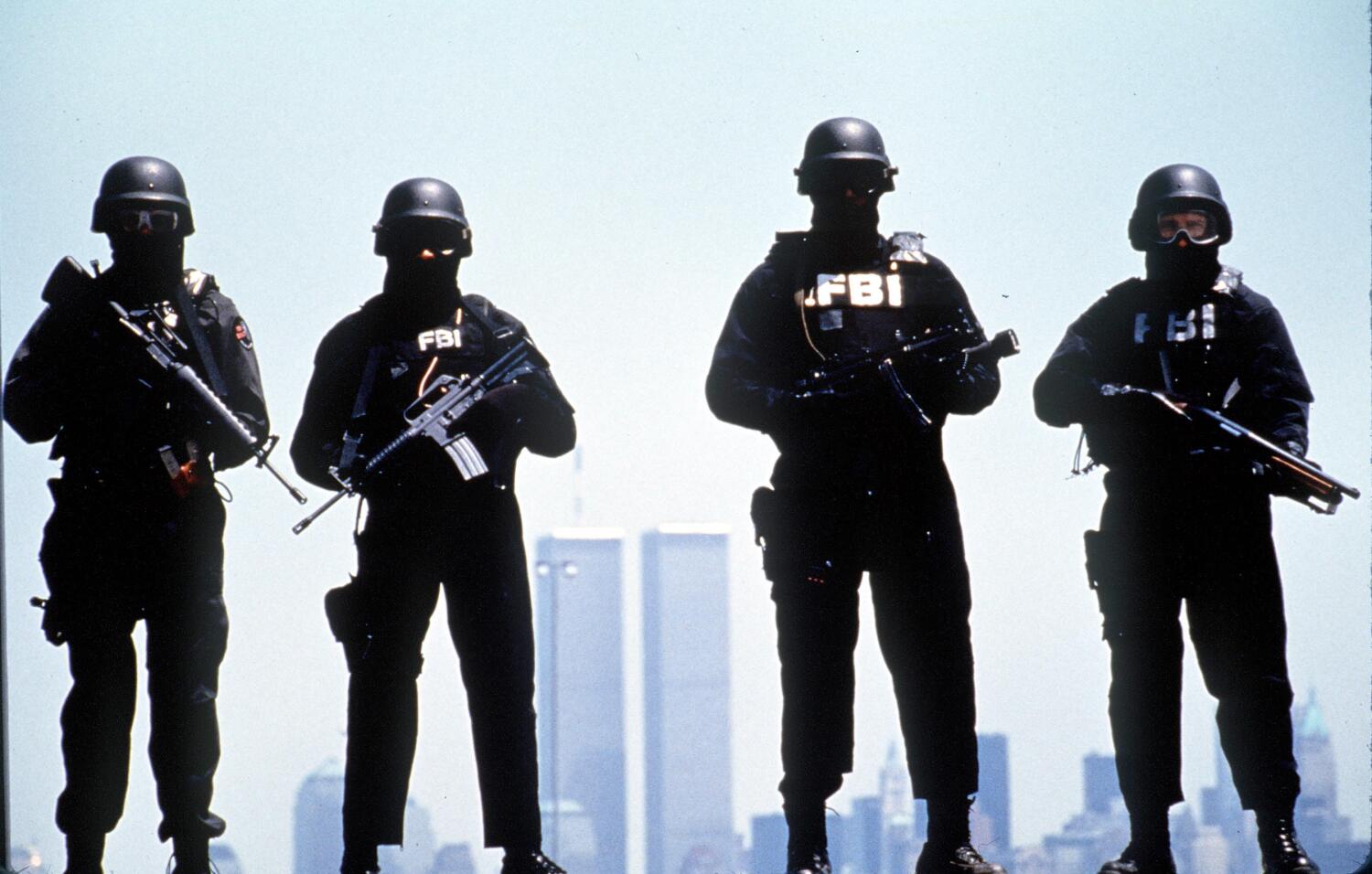
Over the years, individual law enforcement officers have frequently pushed the boundaries of what people might consider acceptable legal standard practice, Schrader said.
The FBI's Counter Intelligence Program of the 1950s and 1960s, he said, was considered a particular black mark on federal law enforcement because of its covert and illegal activities, such as violating people's constitutional rights, engaging in violence, and conducting secretive operations for political reasons.
The big difference here is that this is all happening in broad daylight," Schrader said. "This is happening totally in the open.
How does law enforcement masking change the relationship between citizens and law enforcement?
Many civic leaders across metro L.A. say the practice of masked federal agents has caused confusion in their communities.
"We are receiving questions like, 'How can I know if the masked man detaining me is ICE or a kidnapper?' And, 'Who can protect me if a masked man with a gun refuses to identify himself?'" Mayor of Burbank Nikki Perez
said
Tuesday.
In Burbank, fears of imposters became reality on Sunday when two masked men stopped a woman outside the Mystic Museum in Magnolia Park, Perez said.
According to the Burbank Police Department, the men got out of a white SUV, stopped a woman, and, pretending to be federal immigration agents, asked her for her papers. Thanks to witnesses, Perez said, the woman was able to leave without further harassment or, worse, kidnapping.
"What did not leave our community, or our residents, is a new sense of fear and uncertainty about safety for everyone in our community, regardless of their immigration status," Perez said.
Could lawmakers require federal agents to wear masks?
Some members of Congress are pushing the
No Masks for ICE Act
,
a federal bill that would prohibit ICE agents from using face coverings during operations
, except for specific safety reasons. It would also require agents to wear visible identification that clearly displayed their name and agency affiliation.
But a Republican co-sponsor has yet to come on board. Until that happens, it has little momentum in the GOP-controlled House.
In Sacramento, Democratic legislators have introduced the No Secret Police Act, a bill that would require officers operating in California to provide clear identification and prohibit them from concealing their identity.
But a state law could not control the behavior of federal officers, said David Levine, a law professor at UC San Francisco. "Even if California passed that," he said, "it wouldn't affect the immediate issue of what ICE chooses to do."
Some experts who defend masking say they think every federal agent should display clear identification for everyone's safety.
Definitely, 100%, a badge needs to be visible," Silverman said, adding that he would support federal requirements for agents to show identification. "Same thing with marking... It doesn't matter what agency you're in, you should be able to be identifiable.
In an age when anyone can order a DEA patch or FBI hat, Silverman said it is vital that agents are identifiable.
What I'm scared of is somebody's gonna think that a federal agent is impersonating, but it's gonna be a real agent," he said. "Or vice versa.
What could happen if there was a clash with a masked federal agent?
Levine said he would like to see Bondi, the nation's top government lawyer, take the issue of identification seriously and write an advisory letter to federal agents with clear guidelines on badges, uniforms, and masking.
Somebody is going to make a mistake because of this," Levine said. "Somebody's gonna get shot or killed — and it may well be an officer.
If someone were to pull out their weapon," Levine said, "it would be pretty easy to say, 'I felt threatened' — particularly in a state that allows concealed carry and has a 'Stand Your Ground' law.
They could say, 'I thought I was under attack. I had no idea they were the police. They jumped out of an unmarked vehicle. Nobody had a badge on. Nobody was wearing a uniform.'
If a masked officer with no uniform or identification were to injure, or even kill, someone in a struggle, California officials would not be able to bring criminal charges.
No state prosecutor can bring charges against a federal officer," Obayashi said. "They can't even bring state charges for excessive force.
This story originally appeared in
Los Angeles Times
.